


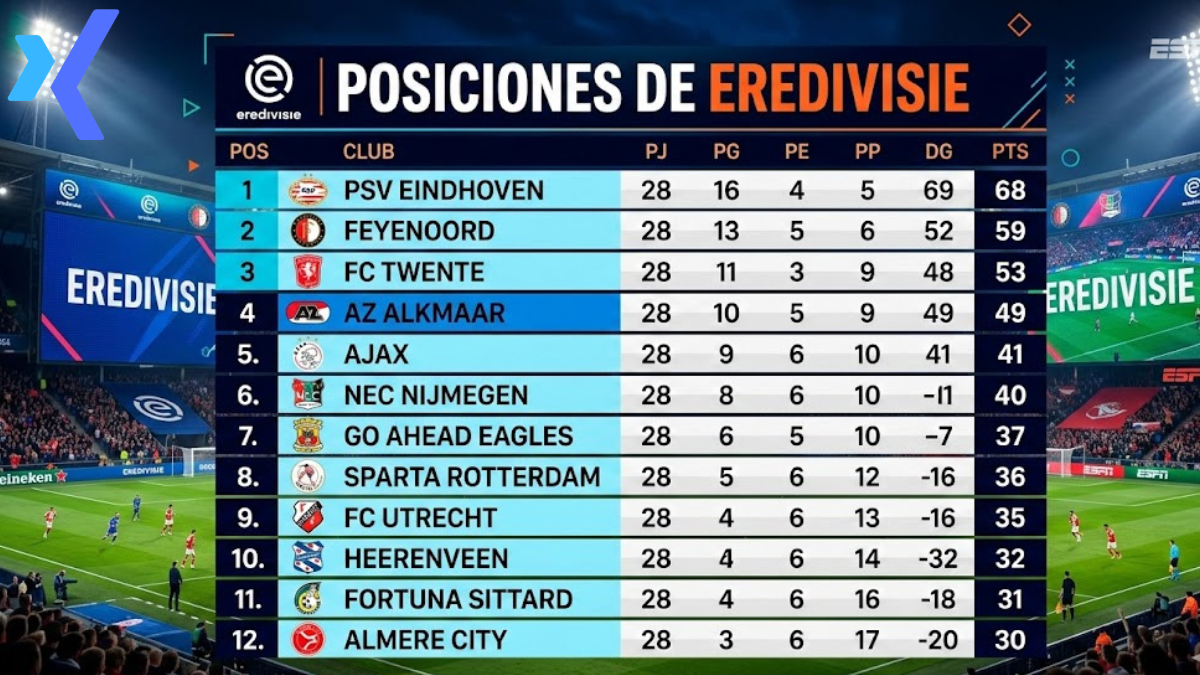
Understanding the posiciones de Eredivisie is essential for any fan of Dutch football. Every season in the Netherlands’ top professional league delivers excitement, twists, and competition that keeps supporters eagerly checking the standings week after week. Whether you follow Ajax, PSV, Feyenoord, or one of the many rising clubs, knowing how the table shapes up gives context to each match, rivalry, and title race.
In this article, we’ll explore the meaning of posiciones de Eredivisie, how the standings are formed, key teams, implications for European qualification and relegation, and why fans care so deeply about these rankings. You’ll find expert insights delivered in a friendly, easy-to-read style designed to keep you informed and engaged.
What the Posiciones de Eredivisie Really Mean
At its core, posiciones de Eredivisie refers to the league table that ranks all eighteen teams in the Eredivisie. This table is updated after every matchday and reflects each club’s performance through points accumulated, goal difference, and other metrics.
Every team earns points by winning or drawing matches. A win gets you three points, a draw gives you one, and a loss leaves you with none. The standings aren’t just numbers on a page. They determine champions, European spots, mid-table security, and the fight against relegation. When you see a club high up in the posiciones de Eredivisie, you can infer strong form, tactical strength, and consistency.
Fans and analysts alike watch these rankings closely because they encapsulate the story of the league. Are the traditional powers dominating once more? Is an underdog surprising everyone? These questions unfold directly in the posiciones de Eredivisie, making the table a living summary of the Dutch top flight.
The standings also influence club decisions. A team just outside the European spots might invest in new players during the transfer window to push further up the posiciones de Eredivisie. Conversely, a club near relegation might change managers in hopes of sparking a late surge. In this way, the standings matter on and off the pitch.
How the Eredivisie Standings Are Calculated
When we talk about posiciones de Eredivisie, we’re referring to a specific set of rules used to sort teams. The league uses a standard points system, but when teams are level on points, other factors come into play.
The primary criteria in the posiciones de Eredivisie are:
- Points: Total points from wins and draws.
- Goal Difference: Goals scored minus goals conceded.
- Goals Scored: Total goals scored by the team.
Let’s say two clubs are tied on points. The one with the better goal difference takes the higher spot in the posiciones de Eredivisie. If goal difference is also tied, total goals scored becomes the deciding factor. These details ensure a fair yardstick to measure performance over a season.
The table you see in the posiciones de Eredivisie is updated after every match. For example, if Ajax scores four goals in a match and concedes one, its goal difference improves by three, which might propel them up in the standings. Similarly, a narrow loss can dent a club’s position.
Another important aspect is that the Eredivisie season typically consists of 34 matches per team. With so many fixtures, the posiciones de Eredivisie can change dramatically from August to May. A strong start does not always guarantee a high finish, while a slow beginning can be overcome with resilience and form later in the season.
Why the Posiciones de Eredivisie Matter to Fans
For fans, the posiciones de Eredivisie is more than a static table. It’s a pulse check on their club’s health and ambitions. Here’s why supporters are so invested:
First, league position determines qualification for continental competitions. The top clubs in the posiciones de Eredivisie earn spots in the UEFA Champions League and Europa League. This not only brings prestige but also significant financial rewards. For many clubs, climbing just one or two spots in the standings can transform a season.
Second, the table affects local pride and bragging rights. Dutch football is rooted in regional rivalries. When two clubs meet, their positions in the posiciones de Eredivisie add intensity to the encounter. A derby with high stakes in the standings becomes must-watch TV.
Third, relegation battles capture attention in dramatic fashion. Teams at the bottom of the standings fight to avoid dropping into the Eerste Divisie, the second tier of Dutch football. For fans, every match in that fight feels like a cup final, and every point gained in the posiciones de Eredivisie can be crucial.
Finally, the standings offer a narrative through the season. A surprise club climbing into the European spots makes headlines. A dominant streak by a traditional giant like Ajax or PSV builds anticipation. The posiciones de Eredivisie tell those stories in real time.
A Look at Current Standings in the Posiciones de Eredivisie
Below is a sample representation of how the posiciones de Eredivisie might look midway through a season. This example is illustrative and not updated live.
Eredivisie Standings (Example Table)
| Position | Team | Played | Won | Drawn | Lost | GF | GA | GD | Points |
|---|---|---|---|---|---|---|---|---|---|
| 1 | AFC Ajax | 20 | 14 | 4 | 2 | 48 | 18 | +30 | 46 |
| 2 | PSV Eindhoven | 20 | 13 | 5 | 2 | 42 | 20 | +22 | 44 |
| 3 | Feyenoord | 20 | 12 | 4 | 4 | 38 | 22 | +16 | 40 |
| 4 | AZ Alkmaar | 20 | 10 | 6 | 4 | 35 | 25 | +10 | 36 |
| 5 | Vitesse | 20 | 9 | 5 | 6 | 30 | 29 | +1 | 32 |
| 6 | FC Twente | 20 | 8 | 5 | 7 | 28 | 27 | +1 | 29 |
| 17 | Fortuna Sittard | 20 | 4 | 4 | 12 | 22 | 40 | -18 | 16 |
| 18 | Go Ahead Eagles | 20 | 3 | 5 | 12 | 19 | 42 | -23 | 14 |
This gives you a snapshot of where teams sit in the posiciones de Eredivisie. Fans use tables like this to predict outcomes, feel pride or worry about their favorite club’s fate, and engage in discussions with other supporters.
How European Qualification Works from the Standings
The posiciones de Eredivisie directly influence which clubs qualify for European competitions. UEFA announced specific slots for the Dutch league based on country coefficient rankings, meaning the final positions are crucial.
Typically, the top clubs secure the following:
- Champions League: The top two teams often qualify directly or enter in the qualifying rounds. Securing a Champions League place adds prestige and financial gains.
- Europa League / Europa Conference League: Clubs finishing just below the top two often earn spots in these continental tournaments. This keeps the middle of the posiciones de Eredivisie competitive, as teams strive for European nights.
Winning domestic cups also plays into this. If a cup winner finishes outside the European spots, they might still qualify. But if they already secure a high position in the posiciones de Eredivisie, the European place cascades down to the next best-placed team.
These rules make every match matter. Teams pushing for a European position monitor not only their results but also how rivals above and below them are performing in the posiciones de Eredivisie.
The Relegation Battle and the Posiciones de Eredivisie
While the top of the table is exciting, the bottom is equally tense. Clubs near the foot of the posiciones de Eredivisie fight to avoid relegation to the Eerste Divisie.
In the Dutch system:
- The bottom-placed club is often relegated automatically.
- The next two or three teams might enter playoffs involving high-placed teams from the Eerste Divisie.
This structure makes the league dynamic. A team sitting in 15th place might look safe at first glance, but a string of losses can drag them into trouble. Conversely, a team that starts poorly can climb out of the relegation zone with a strong run of form in the posiciones de Eredivisie.
This fight for survival captivates fans. Local supporters will stay glued to the standings, hoping for every point that could lift their club out of danger. In many ways, this struggle is as compelling as the battle for the title.
Key Teams and Their Impact on the Standings
Certain clubs have shaped the posiciones de Eredivisie over the years:
Ajax Amsterdam
Ajax is one of the most successful teams in Dutch football. Known for their youth academy and attacking style, they regularly lead the posiciones de Eredivisie and compete for European titles.
PSV Eindhoven
PSV consistently challenges at the top. With strong financial backing and a solid fan base, PSV’s presence near the top of the standings is almost a tradition.
Feyenoord Rotterdam
Another giant in Dutch football, Feyenoord regularly finds itself near the top tier of the posiciones de Eredivisie. They bring passionate support and tactical strength.
AZ Alkmaar and Vitesse
These clubs often mix with the top sides and fight for European qualification. They demonstrate the depth of competition in the Netherlands.
Each of these teams contributes to the ebb and flow of the standings. A mid-season slump by one can open the door for another to rise, making the posiciones de Eredivisie unpredictable and exciting.
Quotes from Experts on League Standings
Here are some insights from football analysts on why the posiciones de Eredivisie matter:
“The Eredivisie standings are more than a snapshot. They tell the story of consistency, youth development, and tactical evolution.”
Football Analyst, Johan de Vries
“Every point in this league feels significant because of how tight the table can be. Teams rise quickly in the posiciones de Eredivisie, and others fall just as fast.”
Dutch Football Commentator, Marijke Bos
These perspectives highlight how the standings reflect deeper themes in the league beyond just numbers.
Conclusion
The posiciones de Eredivisie offer football fans a view into the heart of Dutch football. From title races to relegation battles, these standings encapsulate competition, drama, emotion and achievement. Whether you check the table daily or weekly, understanding how it’s calculated and what it means gives you a richer experience as a supporter.
Keep an eye on the standings to follow your club’s journey, anticipate European nights, and join conversations with fans around the world. After all, the story of each season is written one match at a time and reflected in the posiciones de Eredivisie.
Frequently Asked Questions (FAQ)
What exactly are the posiciones de Eredivisie?
The posiciones de Eredivisie are the standings or league table that ranks clubs in the Dutch Eredivisie based on points, goal difference and goals scored throughout the season.
How often are the posiciones de Eredivisie updated?
Standings are updated after every matchday in the Eredivisie. This means fans can expect changes most weeks, especially during tight races.
Why do the posiciones de Eredivisie matter for European competitions?
The final standings determine which clubs qualify for tournaments like the UEFA Champions League, Europa League and Europa Conference League. Higher ranking in the table increases a team’s chances of playing in Europe.
Can the posiciones de Eredivisie change drastically mid-season?
Yes, the standings can shift significantly due to winning streaks, injuries, or tactical changes. That makes following the posiciones de Eredivisie exciting all year.
What happens to teams at the bottom of the posiciones de Eredivisie?
Teams at the bottom risk relegation to the Eerste Divisie. Often, the lowest-placed club is relegated automatically, while others might face playoff matches to retain their place in the top league.
