








Key Takeaways
⦁ Compact data centers enable optimized computing in space-constrained environments.
⦁ Modern technology is making small-scale, robust data centers increasingly attainable for many businesses.
⦁ Staying abreast of innovations and sustainable practices ensures resilient, future-ready data centers that can scale with demand.
Table of Contents
⦁ Rising Demand for Compact Data Centers
⦁ Technological Advancements in Small-Scale Data Centers
⦁ Edge Computing and Its Impact on Compact Data Centers
⦁ Sustainability in Compact Data Center Designs
⦁ Modular and Scalable Solutions
⦁ Challenges and Considerations
⦁ Future Outlook
As digital transformation accelerates across industries, organizations are increasingly seeking ways to optimize their IT operations within constrained physical footprints. Space-saving data centers, particularly those adopting a high-performance 1U server configuration, have become essential in environments where real estate is at a premium or edge computing workloads demand proximity to end users. Businesses navigating modern workloads must ensure their infrastructure not only delivers power and reliability but also accommodates spatial constraints and energy-efficiency requirements.
Recent advancements have enabled the deployment of powerful, resilient infrastructure in small spaces without compromising speed or reliability. Decision makers are faced with a growing array of options for compact, modular data centers that rival their larger counterparts in capability. Understanding these trends is crucial for adapting digital infrastructure to evolving demands.
Rising Demand for Compact Data Centers
The increased proliferation of IoT, smart devices, and real-time analytics applications has fundamentally shifted how businesses must approach their IT resources. Traditional large-scale data centers are not always suitable, especially for edge deployments or urban environments with spatial limitations. Organizations such as hospitals, retailers, and manufacturing facilities often need to process and store data locally to reduce latency and bandwidth costs. As a result, compact data centers are emerging as the go-to solution for minimizing operational delays while delivering robust, near-the-source computing power.
Small-scale data centers also offer business continuity by providing modularity and redundancy in smaller packages, which is vital as industries work to prevent single points of failure in their digital ecosystems. Markets and sectors with limited access to traditional data center space have found compact deployments essential for supporting next-generation workloads.
In addition to these operational benefits, pressure from regulatory bodies and evolving business practices necessitates secure, available, and localized infrastructure. These trends contribute to a steady rise in demand for space-efficient solutions that allow organizations to remain agile and responsive to customer needs.
Technological Advancements in Small-Scale Data Centers
Recent years have seen substantial progress in the design and technology behind compact data centers. Advancements such as low-power, high-density server architectures and advanced thermal management systems have transformed what is possible in small spaces. Today’s solutions include all-in-one racks, highly efficient power distribution units, and automated monitoring tools that deliver enterprise-class performance in minimal footprints. Innovations like liquid-cooling systems, once reserved for larger facilities, are now being adopted for small data center environments, further increasing operational density and efficiency.
Artificial intelligence and machine learning-driven automation are also helping administrators efficiently manage resources, preventing downtime and optimizing workloads based on real-time sensor data. By leveraging these tools, businesses can maintain high uptime and ensure system security while still meeting physical and financial constraints.
Edge Computing and Its Impact on Compact Data Centers
The emergence of edge computing has created a new imperative for localized, compact data center infrastructure. Edge computing processes data closer to where it is generated, often at remote sites or near end users, to improve response times and minimize connectivity bottlenecks. Compact data centers have become indispensable for supporting edge applications, acting as intermediaries between core data centers and devices at the network’s perimeter.
Industries such as healthcare, retail, and logistics now rely on near-instant access to data. In these fields, latency-sensitive applications depend on the swift processing capabilities that only local, compact data centers can provide. These facilities also boost data privacy by keeping sensitive assets within a controlled on-premises environment.
Sustainability in Compact Data Center Designs
As data centers become increasingly vital in a connected world, their environmental footprint is under greater scrutiny. Compact data center design now routinely integrates energy-efficient hardware, advanced airflow management, and renewable energy sources wherever possible. Many organizations invest in eco-friendly cooling systems such as adiabatic and free-air cooling to reduce electricity consumption and greenhouse gas emissions. This sustainable design approach not only supports
corporate responsibility goals but also helps reduce operational costs over time.
Further, software-defined power and intelligent monitoring systems support dynamic energy distribution, eliminating waste and ensuring optimal use of all resources. Experts at Forbes Tech Council report that green certification and carbon-neutral initiatives are set to become standard elements of modern data center planning and operation.
Modular and Scalable Solutions
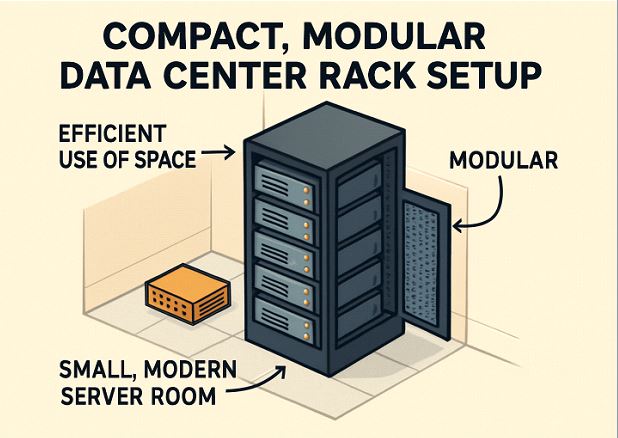
One of the defining features of future-ready compact data centers is modularity. Modular data center solutions allow businesses to start small and add capacity as required, without extensive construction or infrastructure overhauls. Prefabricated modules, containerized data centers, and scalable rack systems provide a fast, cost-effective way to address fluctuating demand. These modular solutions are not only easy to deploy but also support seamless, incremental growth, reducing the risk of overprovisioning or unnecessary capital expenditure.
Deploying modular units further enhances disaster recovery and redundancy planning, enabling organizations to replicate critical infrastructure quickly across geographically disparate locations. With the right modular and scalable framework, adapting to unforeseen changes in data processing needs becomes straightforward and predictable.
Challenges and Considerations
Despite their numerous advantages, compact data centers also pose unique challenges. Ensuring efficient cooling in confined spaces is one of the most significant challenges, as is effective power distribution and redundancy management. Security poses another challenge, both physically and digitally, in decentralized and edge deployments. Organizations must address these risks through layered security measures, comprehensive monitoring, and robust disaster recovery planning.
A successful compact data center deployment relies on meticulous planning, including capacity forecasting, stringent access controls, and compliance with regulatory frameworks. Partners with relevant industry expertise can help businesses design and operate secure, compliant infrastructure even in the smallest spaces.
Future Outlook
Looking ahead, the trajectory for compact data centers is clear: adoption will continue to accelerate as advancements in hardware and management systems make small-scale deployments more viable and cost-effective. The rapid rise of the Internet of Things, artificial intelligence, and distributed cloud services will further propel the demand for strategically located, energy-efficient micro data centers. Innovations in sustainability and modularity will shape how businesses respond to emerging needs and environmental pressures, ensuring compact data centers remain at the core of global digital transformation strategies.


