








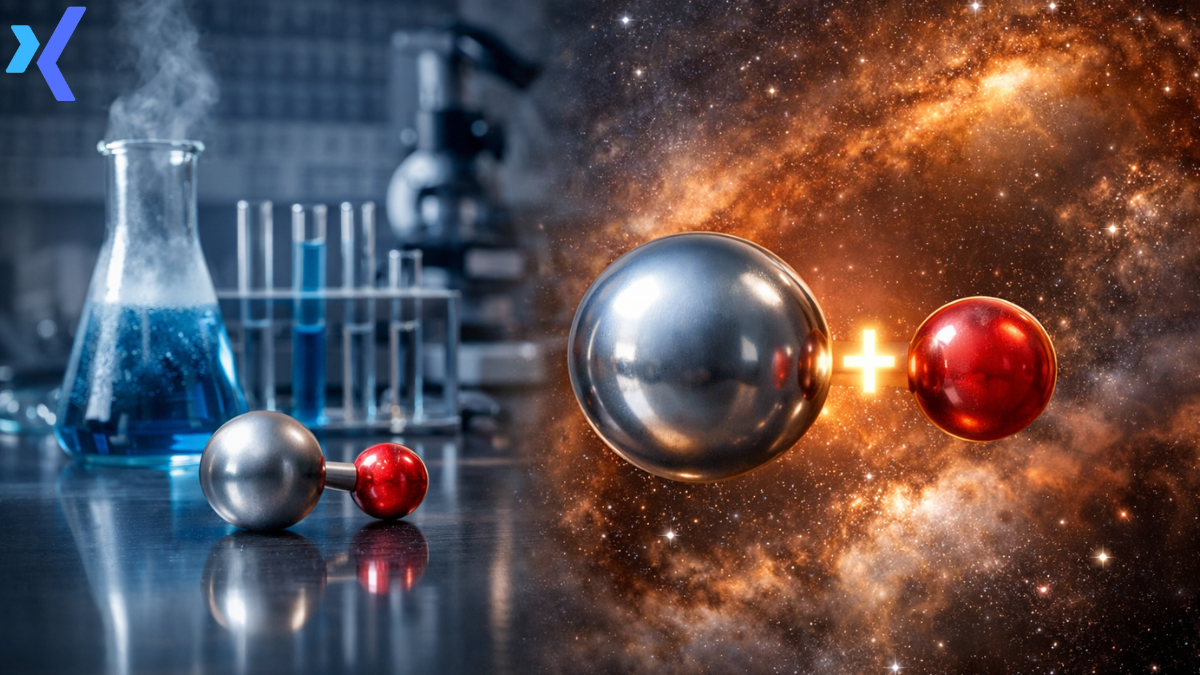
When you first encounter the term helonium definition, it might feel unfamiliar, even mysterious. In scientific literature and technical sources, helonium refers to a very specific chemical species known as the helium hydride ion, often written as HeH⁺. It is a positively charged ion made up of one helium atom and one hydrogen atom that has lost an electron, and it represents one of the simplest and oldest molecular forms in the universe.
In informal online spaces, you might also come across helonium used as slang. In that sense, it’s a playful, metaphorical word people use to describe something light, whimsical, or felt like floating on air. That meaning comes from a cultural twist on the real scientific concept but is not part of formal scientific definitions.
Understanding both uses of helonium definition helps open the door to conversations that range from chemistry and cosmology to language evolution and internet culture.
The Scientific Meaning Behind Helonium
At its core, the helonium definition in science describes a chemical ion called helium hydride. This ion has the formula HeH⁺, meaning that a helium atom is bonded with a hydrogen atom in a positively charged state. It’s important because it’s the lightest heteronuclear ion, meaning it’s made from two different kinds of atoms and carries a charge.
Helonium (HeH⁺) holds a special place in scientific history and astrophysics. Researchers believe it was one of the first molecular species to form in the early universe after the Big Bang, making it a cornerstone for understanding early chemistry and the transition from atomic to molecular eras in cosmic evolution.
From a chemical perspective, this helonium definition also underscores why it’s so reactive. The positive charge and simple structure make it eager to interact with other atoms and molecules, which is why it’s rare on Earth under normal conditions.
How Helonium Was Discovered and Studied
The journey toward understanding helonium definition began nearly a century ago in controlled laboratory environments. Scientists first created helium hydride ions in the 1920s by passing protons through helium gas and observing the resulting charged species.
But for many decades, that remained a laboratory curiosity. Researchers predicted that helonium should exist in space, particularly in environments filled with ionized gases and high-energy conditions. It took until 2019 for astronomers to detect helium hydride ions in a distant nebula, reaffirming long-standing theoretical models about early cosmic chemistry.
These discoveries deepen our understanding of how the universe evolved chemically from its earliest moments to the complex systems we see across stars and galaxies today.
Helonium vs. Helium and Other Related Terms
It helps to contrast helonium with more familiar terms like helium and helion to ground the concept. Helium, symbol He, is a noble gas and one of the simplest elements in the periodic table. It is colorless, odorless, and inert under most conditions, and it’s used in products like balloons and scientific equipment.
A helion refers to the nucleus of a helium atom, especially the helium‑3 isotope, consisting of two protons and one neutron, and carrying a positive charge. It is essentially a helium nucleus without its electrons.
In contrast, helonium definition in chemistry refers specifically to the helium hydride ion HeH⁺, which involves a chemical bond between helium and hydrogen in a charged state.
Using these related words together helps make sense of where helonium fits in the hierarchy of chemical species.
Why Helonium Matters in Science
From a big picture view, the helonium definition connects to some of the most fundamental questions in science. If you want to understand how atoms and molecules first came together after the Big Bang, helonium is one of the earliest compounds to consider. Its existence in space helps scientists test theories about molecular formation and star development.
Helonium also plays a role in spectroscopy, which is how astronomers identify elements and ions based on how they interact with light. Because HeH⁺ has a permanent dipole moment, it can be detected through specific emission lines that reveal its presence even across vast distances.
Chemists find helonium interesting because its reaction properties stretch our understanding of how charged molecules behave, especially in extreme environments like high‑temperature plasmas or the atmospheres of certain stars.
Helonium in Everyday Language and Culture
Beyond laboratory research and astrophysics, helonium has spilled over into internet culture as a slang term. People use it humorously to describe feelings or situations that feel light, surreal, or whimsical—as if lifted by the imaginary properties of helium itself.
This playful usage isn’t part of the formal scientific helonium definition, but it shows how language evolves. Just as helium makes balloons float, people playfully imagine helonium as a state of mental or emotional levity. It’s similar to how other science‑inspired words get repurposed for casual conversation.
A Table That Clarifies Helonium and Related Terms
| Term | What It Is | Key Point |
|---|---|---|
| Helium (He) | Element, noble gas | Inert and light gas used in balloons, science, and industry |
| Helion | Helium isotope nucleus | Nucleus of helium‑3, charged particle |
| Helium Hydride Ion (HeH⁺) | Chemical ion also called helonium | One of the first molecules in the universe |
| Helonium (Slang) | Informal expression | Metaphor for light, whimsical mood |
What Helonium Reveals About the Universe
Taking a closer look at helonium definition is also a way of appreciating how fundamental chemistry and cosmology intersect. The universe started with only the simplest elements: hydrogen and helium. What happened next was the formation of molecular bonds that eventually led to more complex chemistry. Helonium, as one of these early molecules, gives scientists a concrete piece of that story.
Its detection in space confirmed theoretical predictions about early universe matter and helps refine models of how stars and galaxies formed. For many researchers, this is a satisfying bridge between math, theory, and what we can observe through telescopes millions of light‑years away.
How Helonium Is Studied Today
Scientists use advanced spectrometers on space telescopes to search for the characteristic light signatures of ions like helonium. Those signatures act like fingerprints in the electromagnetic spectrum, allowing researchers to identify the presence and quantity of specific molecular species even across interstellar distances.
Laboratory experiments recreate conditions similar to space or early universe environments to observe how HeH⁺ forms and behaves. These experiments are complex because helonium ions are highly reactive and do not last long under normal conditions.
Conclusion: Understanding the Helonium Definition
In summary, the helonium definition bridges science and culture. In chemistry and astrophysics, helonium refers to the helium hydride ion (HeH⁺), a simple but historically significant molecular species thought to be among the universe’s first chemical compounds. It highlights the transition from atoms to molecules in cosmic history and continues to inform research in molecular physics and astronomy.
At the same time, helonium has inspired a lighter, metaphorical usage in contemporary language that plays on the idea of buoyancy and whimsy, even if that usage is far removed from formal definitions.
FAQ About Helonium Definition
What exactly is the helonium definition in science?
The scientific helonium definition refers to the helium hydride ion (HeH⁺), a positively charged molecule made of helium and hydrogen atoms. It’s considered one of the first molecules formed in the universe.
Is helonium a real chemical compound?
Yes. Helonium, also called the helium hydride ion, is a real chemical species studied in labs and detected in space, though it doesn’t exist in everyday conditions on Earth.
How is helonium related to helium?
Helonium includes a helium atom bonded to a hydrogen atom with a positive charge. Helium itself is a neutral noble gas element with atomic symbol He.
Why do some people use helonium as slang?
In casual conversation and online culture, people use helonium playfully to describe feelings or situations that are light, floating, or surreal. This usage is informal and not part of scientific terminology.
Where was helonium first detected in nature?
Helonium was first detected in space in a distant nebula in 2019, confirming theories that it existed in the early universe and plays a role in astrophysical chemistry.


